
• eyetracking@ethz.ch
  • +41 44 633 71 59

Category Archives: D-CEET

  • -

Visit us at Scientifica 2026!

The geoGAZElab will participate in Scientifica 2026 with the interactive exhibition “From Looking to Knowing: Eye Tracking and Spatial Decisions”.

What can our eyes reveal about the way we learn, explore our surroundings, and make decisions? At Scientifica, visitors will have the opportunity to discover how eye tracking helps researchers investigate these questions and gain insights into human cognition and behaviour.

Our exhibition features three interactive demonstrations:

Virtual reality training for airline cabin crews
Experience a digital training system developed in collaboration with Lufthansa Aviation Training and explore how trainees visually inspect an aircraft cabin and identify safety-critical information (project: D-CEET).

3D sketch mapping in virtual reality
Create your own 3D sketch map and discover how researchers study the acquisition and representation of spatial knowledge (project: 3D Sketch Maps).

Mobile eye tracking
Try mobile eye-tracking glasses and observe your own visual attention in real time. Learn how gaze data can provide insights into how people attend to information, learn about their surroundings, and make decisions in complex environments. This demonstration showcases research conducted within the MSCA Doctoral Network Eyes4ICU.

Date: 29-30 August 2026

Location: ETH Zurich Main Building (Polyterrasse entrance)

More information

Funding: The presented projects are funded by the Swiss National Science Foundation, the State Secretariat for Education, Research and Innovation, and the German Federal Ministry of Transport.




  • -

100th Anniversary of our Institute

Our lab is part of the Chair of Geoinformation Engineering at ETH Zurich, and therefore also part of the Institute of Cartography and Geoinformation, which was celebrating its 100th anniversary with a large symposium on 4-5 September 2025.

We feel honored being part of this prestigious institute for 14 years. At the symposium, Peter took the chance to reflect about the history of the geoGAZElab (initially called “Mobile Eye Tracking Lab”), how it all started, and the research contributions we have made so far. Slides of Peter’s short presentation are available here.


  • -

ETRA 2025

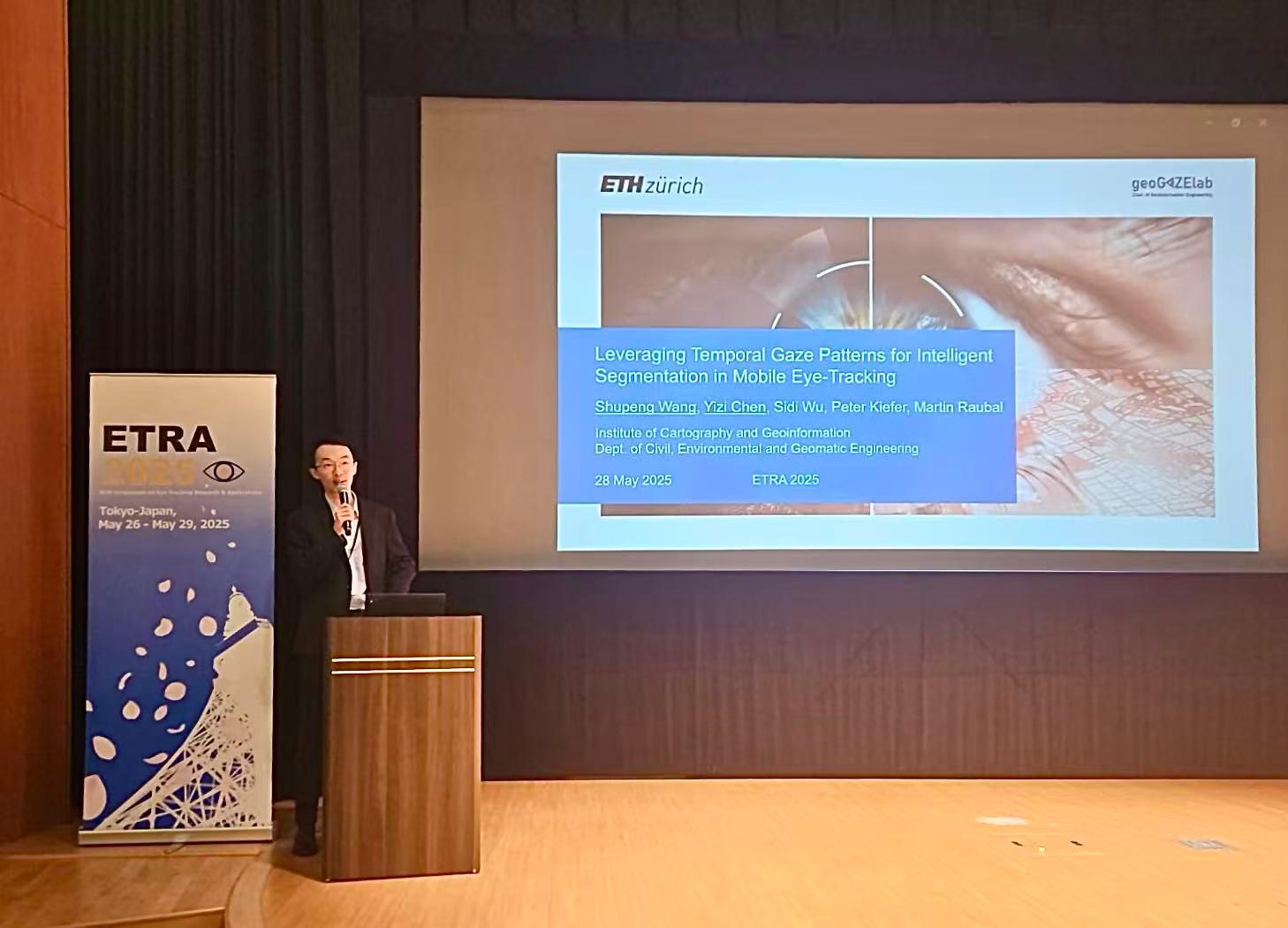
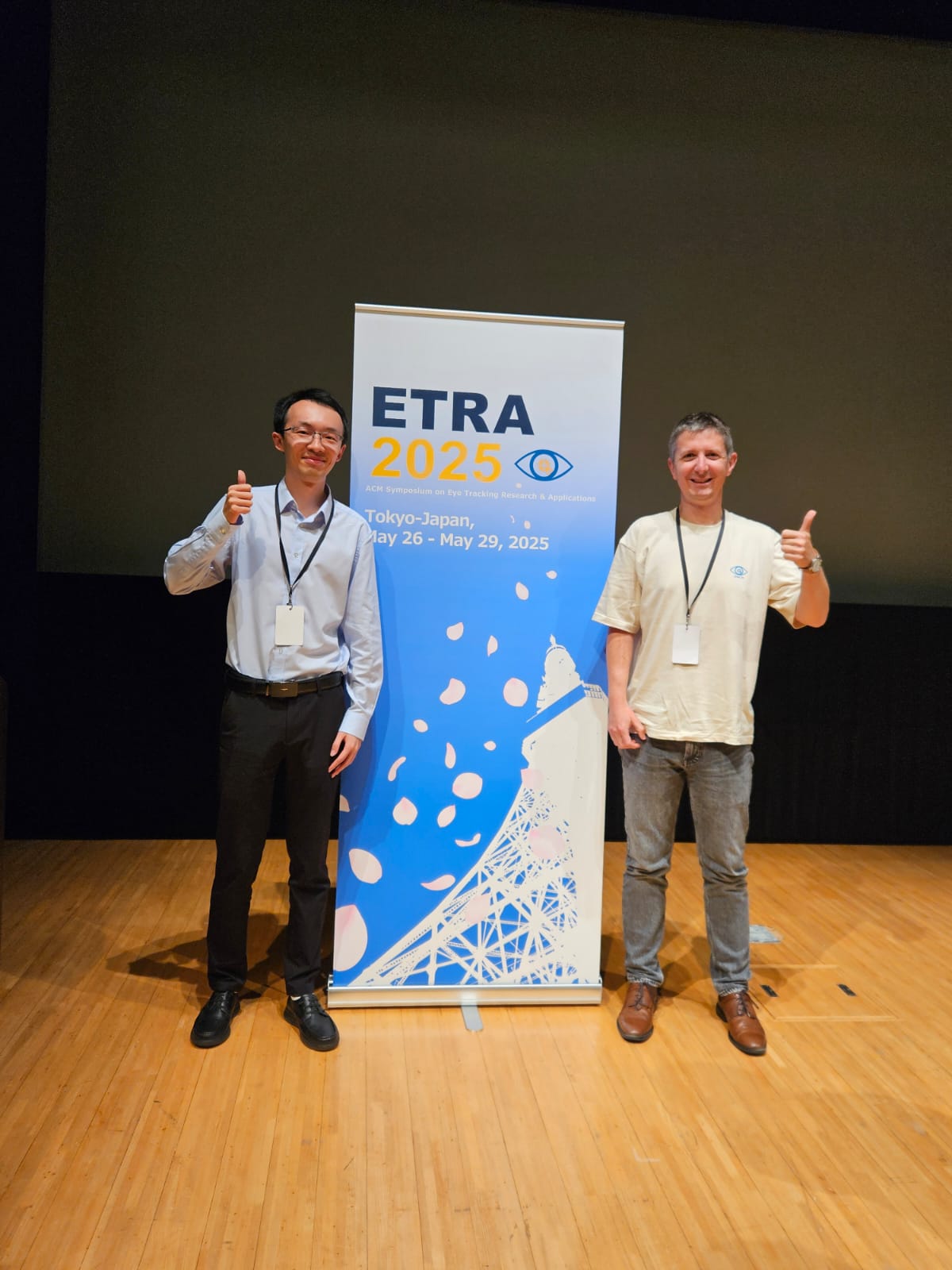
At this year’s ACM ETRA in Tokyo, Japan, Shupeng presented our work on “Leveraging Temporal Gaze Patterns for Intelligent Segmentation in Mobile Eye-Tracking”, which has been published as an article in the PACM CGIT Journal: https://dl.acm.org/doi/10.1145/3729412

In this work, we introduce a novel pipeline that integrates temporal gaze features into the SAM 2 model, significantly enhancing segmentation accuracy for automatic annotations in mobile eye tracking data. The article is co-authored by Shupeng Wang, Yizi Chen, Sidi Wu, Peter Kiefer, and Martin Raubal.

Moreover, 2025 was the second year of Peter’s involvement as one of the ACM ETRA Co-Full Paper Chairs. It was an honor and an exciting time to take on this responsible role for two years.


  • -

D-CEET project launched

We are excited to announce the start of D-CEET, a new project with Lufthansa Aviation Training (LAT), funded by the German Federal Ministry for Digital and Transport (BMDV) in the scope of the mFund innovation initiative.

Today, training for airline crew members takes place almost exclusively in elaborately reproduced cabin dummies and simulators, so-called CEETs (Cabin Emergency Evacuation Trainers). The aim of the D-CEET project is to fully replicate an Airbus A320 CEET as a “digital twin”. The resulting data model is intended to enable fully immersive training of all relevant training content in virtual reality (VR) and additionally as a tablet-based application.

In our sub-project, we will validate the effectiveness of the new training concept using eye tracking and other physiological sensors in systematic studies with crew members. We aim at validating the achievement of competence objectives by measuring and observing behavior as well as by measuring situational awareness and cognitive workload.

Read more about the D-CEET project in a recent press release by LAT, on our website, or on the BMDV website (German only).


Image: Lufthansa Aviation Training GmbH


  • -

Shupeng Wang joins the team

We cordially welcome Shupeng Wang, who has started as a doctoral student in the geoGAZElab. Shupeng holds a Master’s degree in Geomatics from ETH Zürich and a Bachelor’s degree in Geography with an emphasis on Geographic Information Science from the University of California, Santa Barbara, USA. He will be part of the D-CEET project, focusing on the evaluation of new training concepts for airline crew members in a Digital Cabin Emergency Evacuation Trainer.